
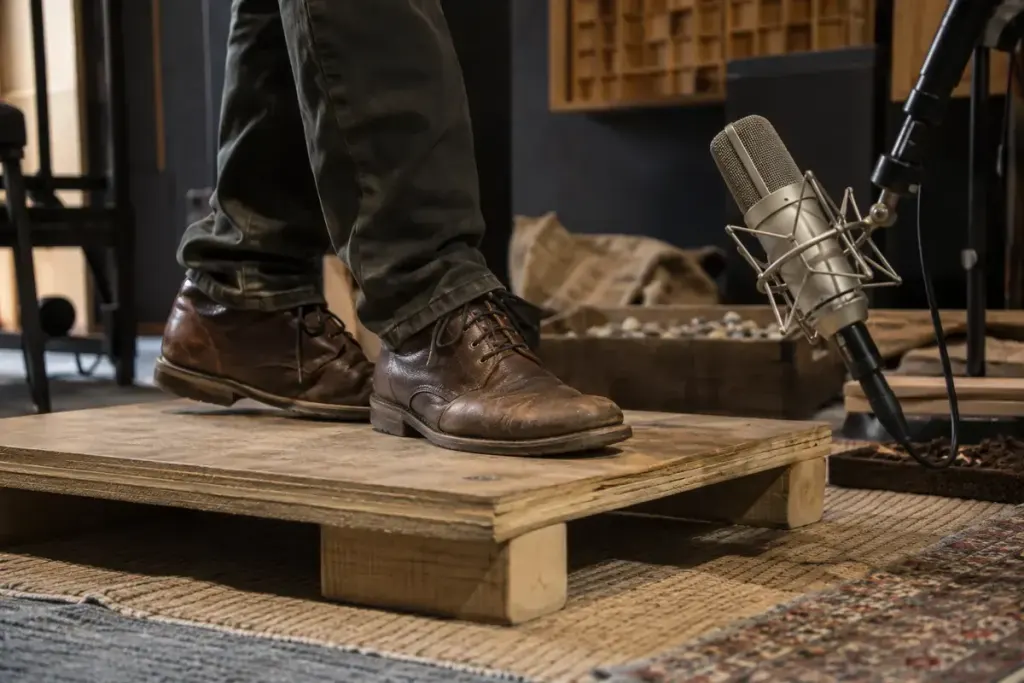
A character walks across a room, sets down a bag and sits. The scene seems ordinary until you listen without following the dialogue. Shoes give the floor a surface. The bag suggests weight. A small fabric movement makes the seated body feel close.
Some sounds of this kind may be performed and recorded after filming, in synchronisation with the picture. This work is commonly called Foley. It gives filmmakers another opportunity to shape the physical detail of a scene; it does not mean every audible footstep was replaced.
The BFI’s Moving Images in the Classroom resource includes work with sound effects and a Foley score. Its practical premise is useful for viewers too: the sound accompanying an image is a construction worth examining, rather than a transparent record we must accept without noticing.
Listen to one crossing of a room
Choose a short scene you can replay legally. On the first pass, follow the story normally. On the second, listen only to the footsteps. Are all steps equally distinct? Do they change as the person approaches? Does a final step land before, on or after an important word?
You are describing the finished soundtrack. Without production evidence, you cannot establish which sound was captured on set, performed in a studio, drawn from a library or assembled from several sources. “The last step is unusually prominent” is a stronger observation than “the Foley artist used a heavy boot.”
For a thought experiment, imagine the same image with three alternatives: soft soles on carpet, hard heels on a hollow floor, and almost no audible steps. The first might make the room feel absorbent; the second could draw attention to the arrival; the third might leave the voice in charge. These are possible readings, not fixed emotional meanings.
The interesting detail may be a missing sound
Watch a hand touch a door handle. If the sound is absent, ask what else occupies that instant. Music, dialogue or silence may be directing attention elsewhere. Realism does not require every visible action to announce itself at equal volume.
A good film note can stay modest: name the action, describe the sound and explain how it changes your attention. You do not need to identify a studio technique by ear to appreciate the choice. Once small sounds become audible to your attention, an apparently quiet scene often has far more movement than you remembered.
AI-generated editorial illustration; not a documentary photograph.