
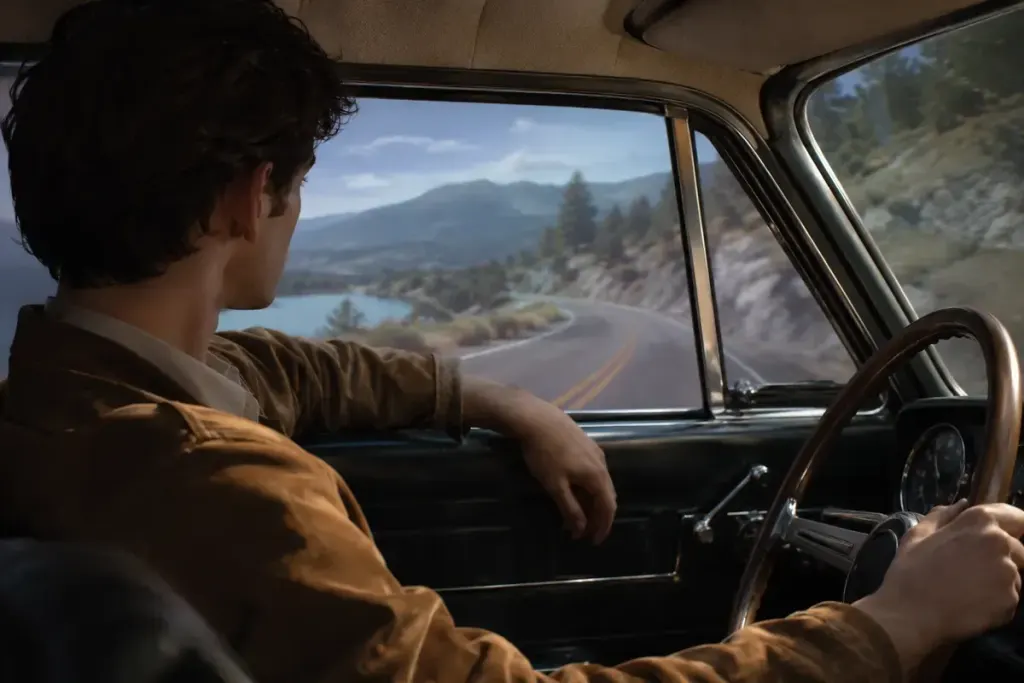
A character sits in a car while a road moves past the rear window. The image asks us to accept one journey, but the scene may have been built from two different moments of photography: a recorded background and a performance staged in front of it.
That possibility is the starting point for understanding rear projection. It is also a reason to look at a familiar film image with curiosity rather than treating a visible effect as an automatic failure.
Two layers meet in the camera
The Columbia Film Language Glossary describes a still or moving image projected onto the back of a translucent screen, with live action photographed in front. The camera combines the projected background and the foreground performance in one image. Moving scenery behind a stationary car is a typical application.
This is a description of the technique, not proof that a particular shot used it. Production documentation is stronger evidence than a viewer’s guess based on a soft-looking background. Other techniques can also combine actors with a setting photographed or created separately.
Watch how the scene makes the journey believable
Choose a short car conversation in a film you can revisit. First watch the actors’ timing: when do they glance outward, brace, or respond to something beyond the vehicle? On a second viewing, follow the background’s direction and pace. On a third, notice the lighting on faces and the car interior.
These passes give you separate observations. “The scenery moves steadily while the actor turns suddenly” is more precise than “the background looks fake”. You can then ask whether the relationship heightens tension, creates comedy or simply keeps attention on the conversation.
Do not assume that realism is the only possible aim. A deliberately conspicuous studio effect may suit a film’s visual language. Equally, an effect can distract you without proving that the filmmakers intended that distraction. Keep your response distinct from a claim about their purpose.
In a viewing note, describe one point where the layers seem to cooperate or pull apart. Rear projection becomes more interesting when you see it as a negotiation between performance and pictured space, not just a trick to be exposed.